
telling a new story of accountability


By Brooke Goff September 28, 2025

telling a new story of accountability


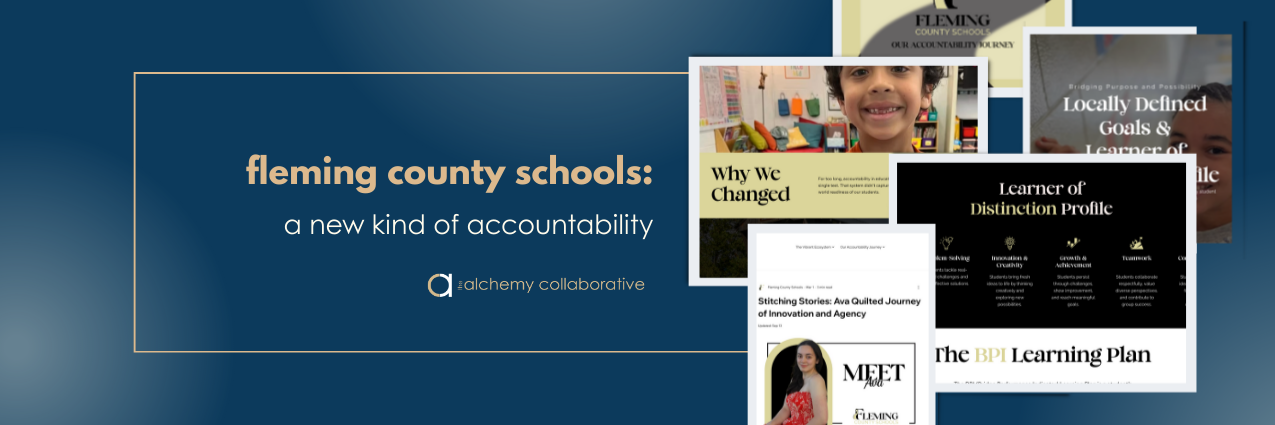
Fleming County Schools (FCS) recently unveiled a new accountability system called Measures of Quality 4.1 (MoQ 4.1), a bold framework that represents a shift in how school success is defined and shared with the public. With the support of Alchemy Collaborative, the district designed and launched fleming.vibrantaccountability.com, a responsive, story-driven platform that reimagines what accountability can mean for students, families, and communities.


This launch is more than a local milestone. It positions Fleming County (and Kentucky more broadly) at the forefront of a national conversation about how schools can measure what matters most.


the bigger vision: united we learn


Kentucky’s United We Learn initiative is the foundation for this work. Launched as a statewide vision for the future of education, United We Learn calls for schools to move beyond test-driven accountability and instead emphasize deeper learning, student voice, and authentic measures of success.


The state has encouraged “L3 districts” to prototype new accountability models that combine state requirements with local priorities. These pilots are designed to demonstrate how communities can define quality in ways that resonate beyond standardized test scores.

Fleming County has been building its local accountability framework since 2017. MoQ 4.1 is the district’s answer to the United We Learn challenge: a comprehensive model rooted in their Vibrant Learning Framework, which emphasizes agency, resilience, relevance, and purposeful learning.


alchemy’s role in the launch


As the district prepared to take MoQ 4.1 public, Fleming County turned to Alchemy Collaborative to help make the complex understandable and the abstract tangible.


Our role focused on three key areas:


  • Bridging policy and public understanding: Accountability models often use technical language that can feel inaccessible to families. We worked with Fleming leaders to translate terms like “Learner of Distinction” into clear, family-centered language that builds pride and connection.
  • Building sustainable systems: A one-time report would not be enough. Our team designed and coded a custom website that allows Fleming to update stories, visuals, and data year after year. The system is built for sustainability, ensuring MoQ 4.1 remains a living, evolving accountability platform.
  • Humanizing the data: We helped integrate student portfolios, authentic quotes, and real-world projects into the accountability story. The site features student work in a way that makes the measures personal and relatable. Data is important, but people connect most deeply with stories.


At Alchemy, we believe communication is an act of teaching. That principle guided every choice we made in supporting this launch.


why “stories over scores” matters


For years, accountability has been narrowly defined by test results. While test data has its place, it rarely captures the full breadth of what students know and can do. Fleming County’s MoQ 4.1 challenges that paradigm by elevating the importance of student narratives.


One example is Alexandra’s transportation project, which is featured on the site. Instead of being represented only by a number, Alexandra’s work showcases her creativity, problem-solving, and readiness to tackle real-world challenges. Stories like hers make the concept of “durable skills” visible for families and community members.


By integrating both quantitative data and qualitative evidence, MoQ 4.1 provides a more balanced and trustworthy picture of student growth. Parents can see test scores alongside project-based learning artifacts. Community members can connect statistics with stories of resilience and innovation.


This blend is the future of accountability.


lessons for other districts


While Fleming County is the exemplar today, their story offers important lessons for other districts considering how to reimagine accountability.


  1. Invest in communication from the start. Accountability frameworks take years to design, but without clear public storytelling, the work risks being misunderstood. Communication must be woven into the foundation.
  2. Balance numbers with narratives. Families need data for credibility, but stories for connection. Districts that prioritize both will earn greater trust.
  3. Design for sustainability. Accountability is not a one-time event. Systems must be built to grow, adapt, and remain transparent year after year.
  4. Center student voice. When accountability highlights authentic student work, it shifts from being a compliance exercise to a celebration of learning.


These principles are scalable. What Fleming has built for MoQ 4.1 is not a one-off solution...it is a model that other communities can adapt to their own context.


looking ahead


The launch of MoQ 4.1 is more than a success story for one district. It is a signal that Kentucky is ready to lead nationally in redefining accountability. With United We Learn as the vision, and local exemplars like Fleming as proof of concept, the Commonwealth has an opportunity to demonstrate that innovation in accountability can be homegrown and sustainable.


For Alchemy Collaborative, this partnership represents exactly what we are here to do: support districts in turning complex frameworks into clear, human-centered systems of communication. Our work with Fleming County has reinforced that accountability, when done well, can be an engine for trust, pride, and engagement.


an invitation to reimagine accountability


Accountability should not be something done to schools. It should be something built with communities, in ways that are transparent, meaningful, and deeply human.


Fleming County Schools has shown what is possible. They have redefined accountability as a system that honors both scores and stories, both data and student voice.


We are proud to have been their partner in this launch. And we believe other districts can take inspiration from their journey.


👉 Explore fleming.vibrantaccountability.com to see the model in action.


If your district is ready to reimagine accountability, let’s talk about how Alchemy can help you design the systems and stories that will build lasting trust in your community.


read our most recent posts

By Brooke Goff July 21, 2026
Most principals are watching local accountability happen from the hallway. You don't have to wait for an invitation. There is a teacher in a school you probably know. Maybe you have someone like her on your team right now. She runs the PLCs. She sits in on planning sessions across grade levels. She knows which classrooms are doing cross-curricular vibrant learning work this quarter, and she knows which teachers need extra support to pull it off. When something remarkable happens in a student's learning, she finds out. She takes the photos. She writes the caption. She is the reason the school's story gets told at all. And she is one person. When local accountability arrives at your building (and it is arriving) it is going to ask for documented vibrant learning evidence, a Portrait of a Learner that lives somewhere public, data that shows your community what your school actually stands for. And if your answer to any of those requests runs through one person's head, one person's phone camera, one person's memory of what happened in third period on a random Tuesday in October, you have a fragility problem. Not a people problem. A systems problem. And it is fixable, but only if you start now, before the district finishes building the dashboard you will eventually be feeding. Here is what I want principals to know before anything else: you are not behind. You are not failing. The local accountability conversation in Kentucky has been happening almost entirely at the district level, and the assumption buried inside a lot of that work is that principals are naturally in the loop. That superintendents are passing information down. That buildings are ready. Most of them are not. And that is not the principal's fault.  What is within a principal's control right now is whether the work already happening in their building gets captured in a way that will matter later. Not a new initiative. Not a new platform. Not a new committee. Three practices, intentionally done, that most strong principals are already doing accidentally.
By Brooke Goff July 7, 2026
We didn't raise our rates. A client assumed we had. Four systems that explain what changed -- and what AI made possible that wasn't possible before.
By Brooke Goff June 22, 2026
What happens when your culture lives only in people's heads? The three school communications systems every organization needs but rarely builds.
the golden lens

sign up to our newsletter to stay updated!

Contact Us

SHARE THIS

learn how we can help