
brief your comms director after every meeting they miss
By Brooke Goff • November 9, 2026

Your comms director can't be in every meeting. They still have to tell the story of every one.

A while back, Karri was reading through a list of schools taking part in a statewide program this year. She stopped on one name and told me she thought we should keep that school on our radar.
Months later, someone in my network brought up the same school. As they described what that team was up against, I realized Karri had seen it first.
We're helping that team now. Whatever it turns into for Alchemy is beside the point.
Here's the part that still gets me. Karri isn't in our client meetings. Her lane at Alchemy is care and relationships, which means knowing the people we serve well enough to show up for them. She doesn't sit in strategy calls or write proposals. She saw it anyway, because she'd been reading along.
After every meeting I have with a client, a partner, a prospect, or my coach, Karri gets a short brief. It reads like I'm catching a friend up over coffee: who was there, what they're carrying, what shifted, and what got promised. Since she isn't in the work every day, the brief has to make sense on its own. If I say HB 257, I explain it. If I mention a superintendent, I say how we know them and where things stand. It lands on her board marked read only, so she never owes me a reply.
On Fridays, she reads the week's briefs side by side. That's where the magic happens.
Most communications directors in Kentucky are in Karri's position, with a much harder job. In the best case, a district has a comms department of one. That person can't be in every cabinet meeting, principal meeting, board work session, and parent call. But, they're still expected to tell the story of all of it.
So I want to make the case for one small habit that can pay dividends: brief your comms director after the meetings they miss. Here's why it's worth a few minutes of your week.
they can't tell a story they never heard
The best stories in a district rarely show up as stories. They come up sideways in a meeting. A principal mentions that her seniors just defended their learning in front of a room full of local employers, and then the conversation moves on to bus routes.
If your comms director wasn't in that room, the moment is gone. Nobody meant to lose it. It just never left the meeting.
Local accountability raises the stakes here. A local accountability system only works if the community keeps seeing real evidence of what students are learning, and that evidence lives in exactly these offhand moments. Most districts have plenty of stories. They leak out of the meetings where they're told.
A brief catches them. When someone says something that makes you sit up a little, it goes in. Your comms director can decide later whether it's a spotlight, a board slide, or a line in the superintendent's next update. They can only decide if they know it happened.
they see patterns across the rooms you're in
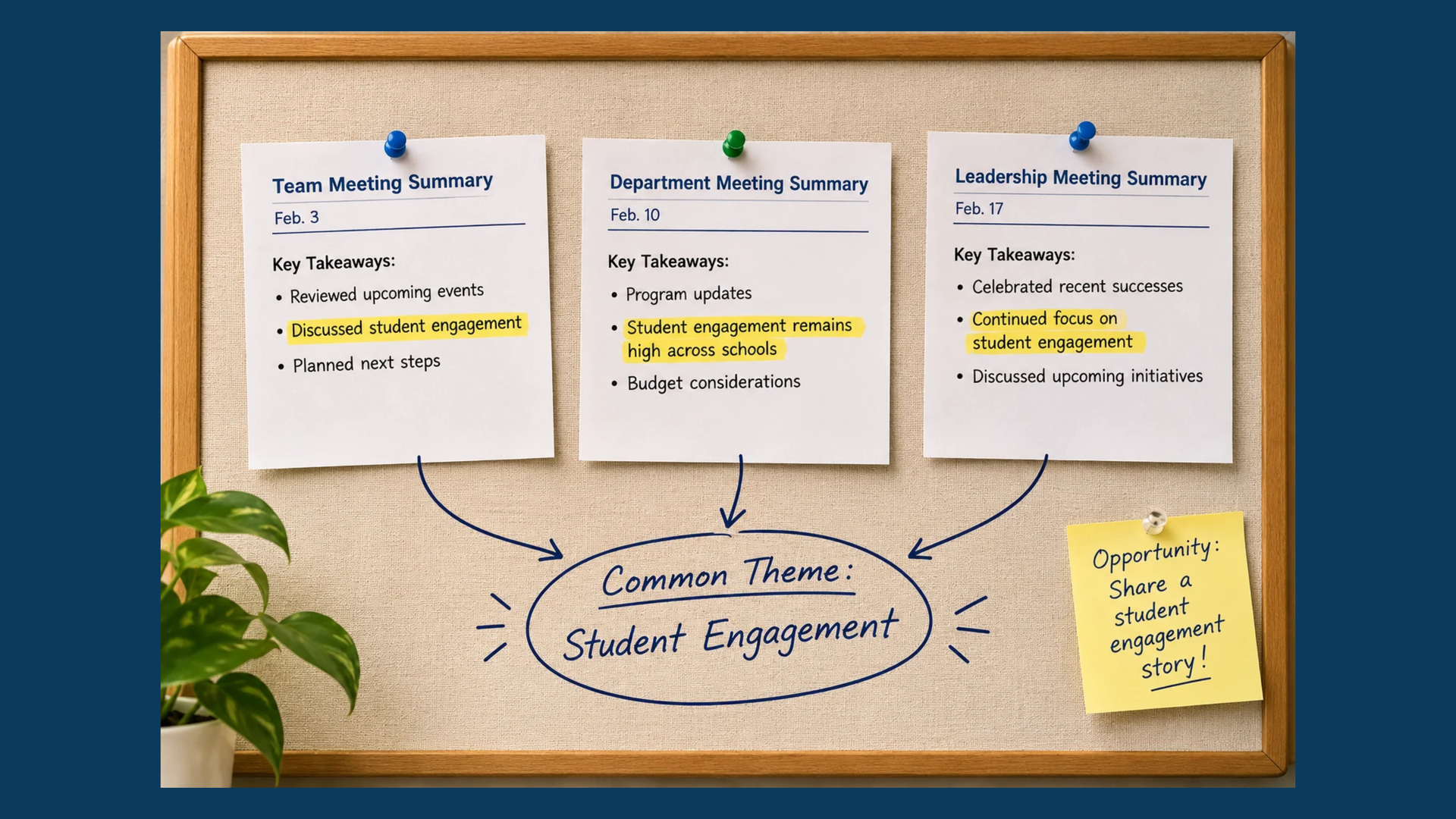
You see your meetings one at a time. The person reading every brief sees them all at once.
That's what happened with Karri and that school. It isn't a one-time thing, either. Karri has raised things for me, Kristen, and Nat that none of us had caught, because she's the only one reading across all of our meetings. Each of us sees our own slice. She sees the whole week.
Your comms director can do the same thing for your district. If three principals mention the same confusion about a new schedule in three separate meetings, nobody in any one of those rooms hears a pattern. The person reading all three briefs does. Now they can write the FAQ before the questions start showing up on Facebook.
they stop finding out with everyone else
You probably know the feeling. A decision gets made in a meeting, and the comms director hears about it from a parent's comment, a staff member's text, or a reporter's call. Now they're writing in reaction, trying to explain something they had no part in shaping.
A brief changes the timing. When your comms director knows what's coming, they can draft the talking points before the board meeting and have the staff email ready the day the news goes public. That's the difference between a district that feels steady and one that always seems to be catching up.
It also tells your comms director something about where they stand. Being kept in the loop says you're part of leadership. Finding out last says the opposite, even when nobody meant it that way.
what goes in the brief
Karri's briefs follow a few simple rules. Your comms director's brief can use them too.
- Start with the moment that mattered. Skip the agenda recap. Lead with the part that made you sit up: the student presentation a principal mentioned, the question a board member kept coming back to.
- Say it plainly. Spell out the shorthand and say why this matters for students and families. Write it so it makes sense to someone who wasn't there, because they weren't.
- Name the people, with care. Who was in the room, what they're carrying, what they said that stuck. Your comms director tells stories about real people, and they can't do that well from a list of attendees.
- Close with what's next. What got promised, by whom, and what might go public and roughly when. That's what your community will eventually ask about, and it's your comms director's head start.
Write it the way you'd catch up a colleague you trust. Short, warm, and honest will do more than polished ever could.
Leave out anything confidential. Personnel and legal matters stay where they belong. The brief carries what your comms director needs to tell the story and get ahead of questions, and nothing more.
I don't type these from scratch. I record my meetings with a notes tool, Claude drafts the brief, and I read it before it goes to Karri. You don't need any of that to start. Three paragraphs typed in the car line will work. Mark it FYI so nobody feels like they owe you a reply.
If you're the comms director reading this, you're allowed to ask for it. Forward this to your superintendent with one line: "Could I get a few sentences after the meetings I miss?" You'll be surprised how often the answer is yes.
Karri didn't have to sit in our meetings to see what was coming. Your comms director doesn't have to either. A one-person department simply doesn’t have time to. They just need the story.
Here's an easy place to start. Pick one meeting your comms director missed this week and send them a few sentences about it before Friday.
That's your first brief.
read our most recent posts


the golden lens
sign up to our newsletter to stay updated!
Contact Us
thanks for signing up!
oops, there was a sign-up error.
please try again later.
SHARE THIS