


three questions that untangle the HB 257 grant
By Brooke Goff • November 23, 2026

a plain map for district leaders before April 1
Most districts think the state's Local Indicators Grant needs a finished public display. KDE's application doesn't ask for one.
Earlier this fall, I sat with a district leadership team that had already done the hard part.
They had brought their community together. They had a framework their board had approved. Then they read the requirements for the state's local indicators grant, looked at each other, and talked themselves out of applying.
The sticking point was measurement. They knew what success looked like in their district, but they couldn't yet say how they would measure it. One leader wasn't willing to put categories on paper just to get in the door, only to rework them after a year of student exhibitions showed what the community actually valued. I understood that.
I'd been chasing my own version of the question. The requirements read like you needed a finished public display before you could even apply. I asked around and heard a lot of "it depends."
So I sat down with the law, KDE's application overview, and the UK Next Gen Local Accountability Continuum, side by side. Most of the confusion came from treating three separate questions as one.
Here they are, kept apart. They got me most of the way to clear. This is my read, not KDE's, and I'll tell you where I'm still unsure.

what does the law require?
House Bill 257 became law in April, and the section on local indicators of quality is shorter than the conversation around it makes it sound.
Districts may build a system of locally developed indicators of quality.
May. It's optional.
A district that does has to include student participation in vibrant learning experiences, plus locally developed indicators of performance. The indicators have to line up with Kentucky's academic standards and let students show they can apply grade-level knowledge in real situations. The law defines vibrant learning as learning shaped by student agency, built with families, the community, and local workforce, and shown through personalized projects or other results. Communities can add priorities of their own, such as student well-being or school safety.
The district also
has to publish an online display of how each school and the district are doing on those indicators, broken out by student group where the law allows.
KDE has to offer technical assistance. KDE may also offer a one-time payment of up to $15,000 per district to offset the cost of developing the indicators. That's the local accountability funding Kentucky districts keep asking about.
The law doesn't mention an application, a deadline, or board minutes. The state board can write regulations to fill in the details, but that section of the law stops at the $15,000.
what does KDE's application ask?
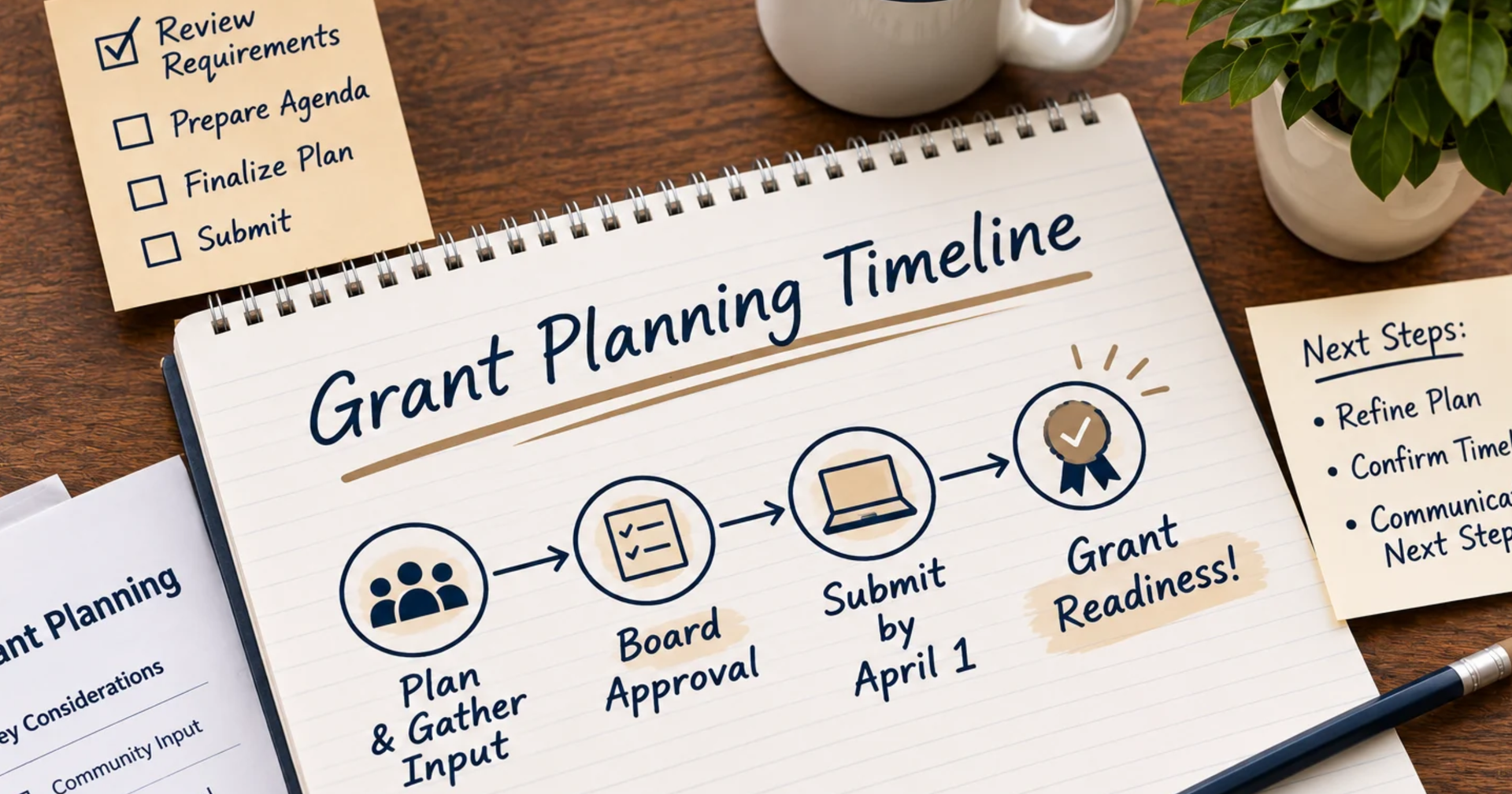
This is where the steps live. KDE's overview of the process asks districts to complete a Local Indicators of Quality diagnostic in the Cognia Improvement Platform. It wants four things:
- A list of the people responsible for developing and overseeing the indicators
- The indicators themselves, aligned to state standards, measuring quality, giving students a chance to apply what they know, and including vibrant learning
- A timeline showing how and when the indicators will be developed further across the district
- Board minutes showing the board approved both the indicators and the timeline
Nothing on that list asks for a public display.
The deadline is April 1, 2027. KDE runs monthly submission reports and issues grants after review. KDE's Regional Innovation Specialists can answer questions, and
KDE reports that its innovation network grew 59% this year, to 52 districts, as more districts take up local indicators of quality.
Notice where the board minutes show up. They're in KDE's process, not in the text of the law, so I'd call them KDE's requirement for the grant.
what can wait until later?
The law requires a public online display of results. KDE's application doesn't ask for one. So a lot of districts are stuck on the one piece the application skips. The display is still coming eventually. It just isn't first.
The continuum helps me put the pieces in order. In column four, a district convenes its community to answer what matters most for the district and how it would know, then identifies its local indicators of quality. In column five, it builds the systems that collect evidence and the online display. In column six, it keeps reporting, and the continuum says indicators may be revised as the work matures.
The application lines up with column four, plus a timeline that points toward five and six. The display is column five work.
Here's what surprised me. KDE's
planning guide for the grant lists community convenings, developing or refining a Portrait of a Learner, and expert help with rubrics and scoring tools. A public display prototype appears on that list too, as one option among many. The guide calls itself a planning resource, not a ruling on allowable costs, so check with your Regional Innovation Specialist before you budget. Still, the measurement work that stopped that district team is the kind of thing the guide describes. It also warns about the funding cliff: anything with ongoing licenses or subscriptions needs a plan for when the $15,000 runs out.
One question I haven't been able to answer
The law says indicators must align with Kentucky's academic standards. KDE has also said local measures may be developed to align with a district's Portrait of a Learner, and 155 of Kentucky's 171 districts have a Portrait or are building one. Portraits are made of broader competencies, though, and I haven't seen one with standards built in. So what does alignment to both look like in practice?
I haven't found anyone who has published an answer. That could be a gap, or it could mean the bar is lower than we think. Either way, it's worth asking KDE's specialists before April.
That district team had a vision, a board vote, and a community behind them. From what I can tell, the application was asking for a plan to get from there to measures, not a finished system.
If you're planning to apply by April 1, the board minutes are the piece with a calendar attached. The vote has to happen before you submit, so your board's meeting schedule sets your real deadline.
If your team is stuck, which of the three questions is it stuck on? Reply and tell me. I'd like to think it through with you.
read our most recent posts

the golden lens
sign up to our newsletter to stay updated!
Contact Us
thanks for signing up!
oops, there was a sign-up error.
please try again later.
SHARE THIS