

the story behind the photo: how schools can capture what’s real (and why it matters)


By Brooke Goff October 27, 2025


“Schools already have everything they need to tell better stories. They just need a way to catch them.”

when a photo makes you stop scrolling

Every once in a while, a school shows us what’s possible when communication becomes part of learning itself.


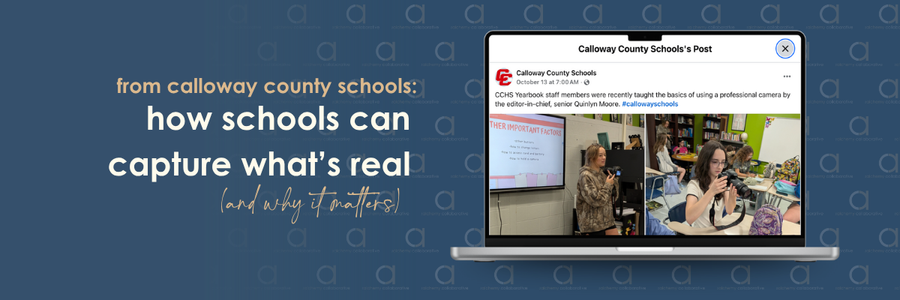
That’s what caught our attention in Calloway County Schools.


Instead of hiring photographers or relying on hurried snapshots, the district is inviting students to help tell their school’s story by capturing classroom life through their own eyes.


The result?


Images that feel authentic and alive. Not because they’re perfectly composed, but because they’re true.


Students are learning how to see - how to notice moments of curiosity, connection, and community - and in doing so, they’re helping their district bridge a gap that so many others are struggling with: how to show what learning really looks like.


It’s a small shift with big implications. When students become the storytellers, communication becomes culture.


what’s missing in most school storytelling


Let’s be honest: schools are doing more than ever, but their stories don’t always show it.


Too often, communication gets squeezed between a dozen other tasks. Photos become proof of attendance, not windows into learning. And the images that make it out to families (group line-ups, stiff smiles, the same award shot three ways) don’t capture the heartbeat of what’s really happening.


It’s not because school leaders don’t care. It’s because capacity is thin and systems are stretched. Most districts don’t have a full-time photographer. Many don’t even have someone whose job is to tell the story.


But here’s the thing: your community doesn’t need more content. They need connection.


They want to see their children curious, proud, joyful. They want to feel what learning feels like.


the examples that show what’s possible


That’s why moments like Calloway County’s stand out. The district has started empowering students themselves to help capture their story, and by doing so, giving them ownership and visibility while bridging a communication gap many districts face.


It’s a smart move on several levels. Students bring fresh perspective, natural creativity, and comfort with technology. They understand their peers’ world and can capture it authentically. And in the process, they’re building real skills - communication, collaboration, digital literacy - the same ones highlighted in so many graduate profile frameworks.


We’re seeing glimpses of this kind of authentic storytelling across the state:


  • At Hillsboro Elementary in Fleming County, the photos are small moments of joy: kids leaning over a project, a teacher kneeling beside a student, sunlight streaming across a classroom. You can tell someone was paying attention, not posing a scene.
  • At Simons Middle School, the images celebrate adolescence with dignity - laughter in motion, hallway conversations, the kind of belonging that middle school often struggles to show.

Each of these examples proves something simple but profound: when people feel seen, they engage. And when communities feel invited into the real story of learning, trust grows.


the systems that make it sustainable

Here’s what’s interesting about these photos: they happen by heart, not by system.

Right now, they rely on individuals who care enough to notice and share. And that’s a beautiful start. But to make storytelling sustainable, to ensure every school can tell stories like these, districts need systems that make it possible.


Systems don’t sterilize authenticity; they protect it.


They help ensure that moments don’t get lost in someone’s camera roll or vanish when a staff member changes roles. Simple frameworks like shared photo libraries, submission forms, and basic photography prompts make it easier for everyone to participate.


When communication is seen as a shared responsibility, not a solo task, storytelling begins to scale.


where to start: a guide for the everyday storyteller


You don’t need to be a photographer to tell a great story.


That’s why we created the Classroom Photography Quick Start Guide: a free resource designed for anyone in a school community who wants to capture learning that feels real.


Inside, you’ll find a simple 5-shot checklist that helps staff and students move from posed to present:


  • Portraits — the faces that show emotion.
  • Action shots — hands raised, eyes focused, moments in motion.
  • Details — the small, symbolic things that make your classrooms unique.
  • Surprises — the candid, unplanned moments that make everyone smile.
  • Connections — the expressions of joy, pride, and belonging that tell the deeper story.

It’s practical, easy to use, and built for real classrooms... where the light isn’t perfect and the schedule never stops.


Even one intentional photo a week can start shifting your district’s visual culture toward something more authentic, more connective, more alive.


the bigger picture


The truth is, every district already has what it needs: people who care, students who notice, stories worth telling.


What’s missing isn’t the heart... it’s the habit.


The systems will come with time, but the mindset starts now: to pause, notice, and share what’s real. Because the goal isn’t to look perfect; it’s to be known.


When schools start capturing what’s honest, they don’t just fill a feed.


They build trust.
They build belonging.
They show their community who they really are.


read our most recent posts

By Brooke Goff July 21, 2026
Most principals are watching local accountability happen from the hallway. You don't have to wait for an invitation. There is a teacher in a school you probably know. Maybe you have someone like her on your team right now. She runs the PLCs. She sits in on planning sessions across grade levels. She knows which classrooms are doing cross-curricular vibrant learning work this quarter, and she knows which teachers need extra support to pull it off. When something remarkable happens in a student's learning, she finds out. She takes the photos. She writes the caption. She is the reason the school's story gets told at all. And she is one person. When local accountability arrives at your building (and it is arriving) it is going to ask for documented vibrant learning evidence, a Portrait of a Learner that lives somewhere public, data that shows your community what your school actually stands for. And if your answer to any of those requests runs through one person's head, one person's phone camera, one person's memory of what happened in third period on a random Tuesday in October, you have a fragility problem. Not a people problem. A systems problem. And it is fixable, but only if you start now, before the district finishes building the dashboard you will eventually be feeding. Here is what I want principals to know before anything else: you are not behind. You are not failing. The local accountability conversation in Kentucky has been happening almost entirely at the district level, and the assumption buried inside a lot of that work is that principals are naturally in the loop. That superintendents are passing information down. That buildings are ready. Most of them are not. And that is not the principal's fault.  What is within a principal's control right now is whether the work already happening in their building gets captured in a way that will matter later. Not a new initiative. Not a new platform. Not a new committee. Three practices, intentionally done, that most strong principals are already doing accidentally.
By Brooke Goff July 7, 2026
We didn't raise our rates. A client assumed we had. Four systems that explain what changed -- and what AI made possible that wasn't possible before.
By Brooke Goff June 22, 2026
What happens when your culture lives only in people's heads? The three school communications systems every organization needs but rarely builds.
the golden lens

sign up to our newsletter to stay updated!

Contact Us

SHARE THIS

learn how we can help