
throwing limbs at problems (and other lessons from frisbee golf)


By Brooke Goff October 27, 2025


when the frisbee got stuck

A few weekends ago, my son Grant and I went frisbee golfing at Freeman Lake Park in Elizabethtown...one of those activities I’ve slowly learned to enjoy, even if I’m still new (and admittedly terrible) at it. It’s become our thing: a chance to laugh, walk, and compete in the most unathletic way possible (at least on my end; Grant is actually pretty good).

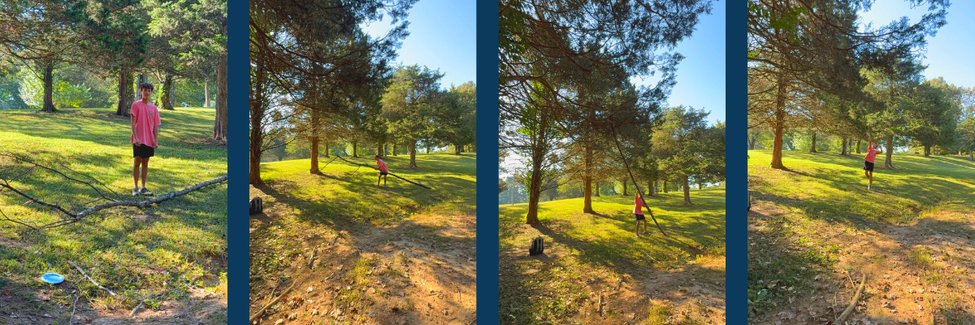
We came to a hole that felt almost impossible: uphill, shaded, and thick with trees. Grant’s arm is much stronger than mine, so when he threw, the frisbee launched straight ahead with force… and went directly into a tree. Mine, lighter and slower, somehow glided past without hitting anything. We laughed, because of course it happened on the very first throw of the round.


What followed was a full comedy routine: shaking the trunk, tossing sticks, even hurling a few small limbs skyward. Nothing worked. The frisbee didn’t budge.


Finally, I spotted a massive fallen limb (basically a small tree) lying nearby. Grant dragged it over, braced his feet, and heaved it into the air while I filmed, laughed, and documented the chaos (because sometimes, that’s my job). After a few attempts, the frisbee finally tumbled free, covering Grant in leaves, dirt and pine needles, but perfectly intact.


It was funny and ridiculous but as we stood there catching our breath (edit: Grant stood there catching his breath and me watching from a distance), I realized something: this felt familiar. How often do we face something that seems impossible, throw everything we have at it, and still watch it stay stuck?


what we do when things get stuck


In our work with schools, we see this all the time. Something in the system (communication, trust, morale) gets stuck. A message doesn’t land. A community feels unheard. The energy of the work starts to stall.


And what do we do? We start tossing “limbs” at it. A new flyer. A social media post. A quick rebrand. A message sent out just to say we tried.

Those small efforts aren’t wrong but they rarely shake loose what’s really stuck. Sometimes, the problem isn’t in the content; it’s in the root system.


The pattern. The posture.


Real movement comes when we pick up something heavier:


  • Patience. Sitting with the tension long enough to understand what’s really going on.
  • Partnership. Inviting others to help shoulder the weight instead of fixing it alone.
  • Perspective. Stepping back to see the bigger picture before rushing to solve it.

That’s the heavier work. It’s not flashy or fast, but it’s the kind that actually frees what’s been lodged in the branches for far too long.


the heavier work of communication

At Alchemy, we talk a lot about the difference between reaction and restoration. Reaction is the quick toss: the small limb. Restoration is the rooted, patient work that takes time, energy, and collaboration.

When districts slow down long enough to listen, align, and rebuild systems together, that’s when communication becomes transformational. That’s when clarity replaces confusion, and trust begins to grow again.


Because in the same way that Grant and I couldn’t dislodge that frisbee on our own, school communication isn’t a solo sport. It’s a shared effort where every voice, every perspective, and every ounce of patience matters.


what we’re learning


That day at Freeman Lake reminded us of something simple but true: some problems won’t come down until you pick up something heavier : patience, teamwork, or a new perspective.


It’s not the easy route. It’s not the quick fix. But it’s the kind that lasts.


So, the next time something in your communication system feels stuck, pause before throwing another limb at it.


Look for what might really move it - maybe a better process, a deeper conversation, or just the willingness to try again, together.


At Alchemy, we’ve learned that communication is often the same. The work that feels impossible at first usually just asks for more patience, partnership, and perspective. It takes shared effort and a willingness to see the bigger picture.


That’s the kind of work we love: the kind that brings things loose, clears the view, and makes room for what’s next.


read our most recent posts

By Brooke Goff July 21, 2026
Most principals are watching local accountability happen from the hallway. You don't have to wait for an invitation. There is a teacher in a school you probably know. Maybe you have someone like her on your team right now. She runs the PLCs. She sits in on planning sessions across grade levels. She knows which classrooms are doing cross-curricular vibrant learning work this quarter, and she knows which teachers need extra support to pull it off. When something remarkable happens in a student's learning, she finds out. She takes the photos. She writes the caption. She is the reason the school's story gets told at all. And she is one person. When local accountability arrives at your building (and it is arriving) it is going to ask for documented vibrant learning evidence, a Portrait of a Learner that lives somewhere public, data that shows your community what your school actually stands for. And if your answer to any of those requests runs through one person's head, one person's phone camera, one person's memory of what happened in third period on a random Tuesday in October, you have a fragility problem. Not a people problem. A systems problem. And it is fixable, but only if you start now, before the district finishes building the dashboard you will eventually be feeding. Here is what I want principals to know before anything else: you are not behind. You are not failing. The local accountability conversation in Kentucky has been happening almost entirely at the district level, and the assumption buried inside a lot of that work is that principals are naturally in the loop. That superintendents are passing information down. That buildings are ready. Most of them are not. And that is not the principal's fault.  What is within a principal's control right now is whether the work already happening in their building gets captured in a way that will matter later. Not a new initiative. Not a new platform. Not a new committee. Three practices, intentionally done, that most strong principals are already doing accidentally.
By Brooke Goff July 7, 2026
We didn't raise our rates. A client assumed we had. Four systems that explain what changed -- and what AI made possible that wasn't possible before.
By Brooke Goff June 22, 2026
What happens when your culture lives only in people's heads? The three school communications systems every organization needs but rarely builds.
the golden lens

sign up to our newsletter to stay updated!

Contact Us

SHARE THIS

learn how we can help