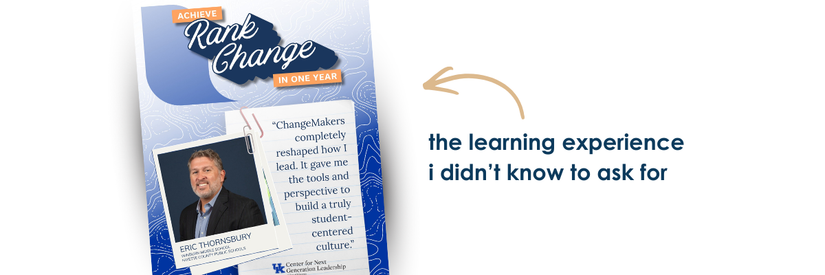

the learning experience i didn’t know to ask for


By Brooke Goff January 20, 2026

why this rank change finally made sense to me

I was never the educator who loved collecting certificates.


I wanted learning that changed how I taught on Monday, and NOT paperwork that lived in a binder or a transcript line that proved I’d checked the box. So when we began partnering with UK Next Gen to help share the story of their ChangeMakers rank change pathway, I didn’t expect it to feel personal.


But it did.


Listening to educators describe their experiences cracked open something I hadn’t fully named before: it wasn’t learning I resisted. It was learning that felt disconnected from real work, real students, and real purpose.


i didn’t hate learning — i hated how it was packaged

For much of my career, professional learning felt transactional. You showed up, logged the hours, submitted the artifacts, and moved on. The learning itself wasn’t always bad, but it rarely stayed with me. It didn’t shape my questions, my confidence, or my practice in a lasting way.


What I wanted (and what I hear so many educators want) was learning that felt practical, innovative, and rooted in the actual challenges of teaching and leading.


Learning that trusted educators as thinkers and designers, not just recipients of content.


That tension is what immediately stood out to me about ChangeMakers.


hearing the stories changed everything

At Alchemy, part of our role with UK Next Gen has been helping surface and share the stories coming out of the ChangeMakers community.


That has meant listening (really listening) to alumni reflect on what shifted for them.


Again and again, the same pattern emerged: people didn’t talk first about rank change. They talked about clarity. Confidence. Purpose.


Eric Thornsbury, a middle school principal, shared how the Learner Agency module reshaped his leadership in an unexpected way. During the program, participants were asked to interview students about their learning experiences and what their ideal school might look like. That simple move (centering student voice as data) changed how Eric approached conversations with teachers and instructional leaders. He’s spoken publicly about how it reframed not just what he leads, but how he leads: with more curiosity, deeper questions, and a clearer focus on student-centered practice.


Then there’s Melanie Hofmann, an elementary art teacher whose story continues to stay with me. Through ChangeMakers, Melanie began experimenting with student-led Exhibitions of Learning. What started as small instructional shifts grew into something transformative: students standing beside their work, explaining their thinking, reflecting on their process, and welcoming families into the learning. Assessment stopped being something done quietly at a desk and became something public, celebratory, and deeply human.


These stories don’t sound like compliance. They sound like growth.


what changemakers actually centers

One reason these stories resonate is that ChangeMakers isn’t built around completion for completion’s sake. The program centers action research, job-embedded learning, and student-centered practices that live inside educators’ real contexts.


Participants aren’t asked to leave their classrooms behind. They’re asked to study them. To test ideas. To reflect, revise, and try again. The work focuses on learner agency, performance assessment, access and engagement, and deeper learning experiences that actually show up in day-to-day practice.


The rank change matters...but it’s not the headline. It’s the outcome of learning that feels relevant and alive.


For educators who, like me, learn best by doing and reflecting, that distinction makes all the difference.


why this work feels aligned with us

At Alchemy, we believe storytelling isn’t just about visibility. It’s about sensemaking. Helping organizations and communities name what’s changing, why it matters, and how people experience it.


Working alongside UK Next Gen hasn’t felt like promoting a program. It’s felt like documenting a shift in how professional learning can work when it’s designed with intention and trust. When educators are treated as professionals capable of inquiry, creativity, and leadership, something unlocks.


Many alumni have described feeling reinvigorated because it was meaningful. Because it connected directly to students. Because it respected their time and intelligence.


As someone who once resisted traditional professional pathways, I recognize myself in those reflections. This is the kind of learning I was craving before I had the language for it.


why i’m sharing this now

Cohort 6 applications are open, and I keep thinking about educators who feel that familiar resistance. The ones who want to grow, but don’t want another hoop.


The ones who are curious, reflective, and ready to rethink practice—but on their own terms.


If you’ve ever felt skeptical of rank change or exhausted by professional learning that asks more of your time than it gives back, this pathway is worth paying attention to.


Not because it’s flashy but because it’s grounded.


read our most recent posts

By Brooke Goff July 21, 2026
Most principals are watching local accountability happen from the hallway. You don't have to wait for an invitation. There is a teacher in a school you probably know. Maybe you have someone like her on your team right now. She runs the PLCs. She sits in on planning sessions across grade levels. She knows which classrooms are doing cross-curricular vibrant learning work this quarter, and she knows which teachers need extra support to pull it off. When something remarkable happens in a student's learning, she finds out. She takes the photos. She writes the caption. She is the reason the school's story gets told at all. And she is one person. When local accountability arrives at your building (and it is arriving) it is going to ask for documented vibrant learning evidence, a Portrait of a Learner that lives somewhere public, data that shows your community what your school actually stands for. And if your answer to any of those requests runs through one person's head, one person's phone camera, one person's memory of what happened in third period on a random Tuesday in October, you have a fragility problem. Not a people problem. A systems problem. And it is fixable, but only if you start now, before the district finishes building the dashboard you will eventually be feeding. Here is what I want principals to know before anything else: you are not behind. You are not failing. The local accountability conversation in Kentucky has been happening almost entirely at the district level, and the assumption buried inside a lot of that work is that principals are naturally in the loop. That superintendents are passing information down. That buildings are ready. Most of them are not. And that is not the principal's fault.  What is within a principal's control right now is whether the work already happening in their building gets captured in a way that will matter later. Not a new initiative. Not a new platform. Not a new committee. Three practices, intentionally done, that most strong principals are already doing accidentally.
By Brooke Goff July 7, 2026
We didn't raise our rates. A client assumed we had. Four systems that explain what changed -- and what AI made possible that wasn't possible before.
By Brooke Goff June 22, 2026
What happens when your culture lives only in people's heads? The three school communications systems every organization needs but rarely builds.
the golden lens

sign up to our newsletter to stay updated!

Contact Us

SHARE THIS

learn how we can help