
🐐 from barn to boardroom: how one henry county student embodies the district’s vision for vibrant learning


By Brooke Goff September 15, 2025

What happens when a student grows up in a system where culture comes first, opportunities are real, and learning extends far beyond the classroom?


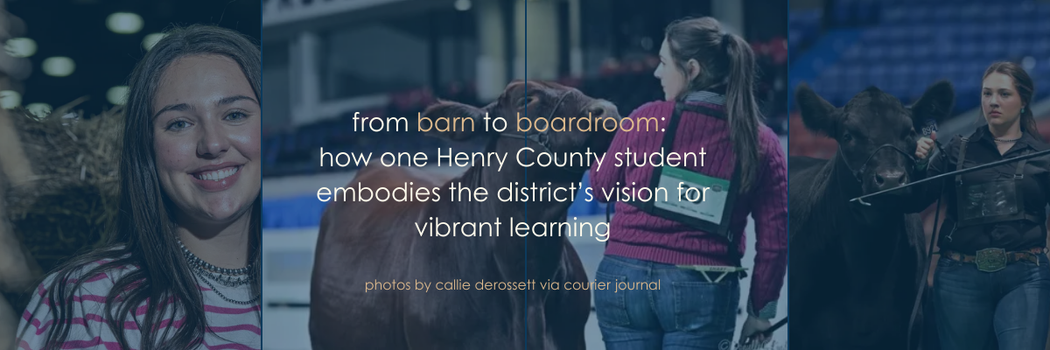
Meet Callie Derossett — fifth-generation Kentuckian, livestock showman, and incoming pre-vet student at the University of Kentucky. Her journey from Henry County barns to the Kentucky State Fair boardroom is more than just a personal success story. It’s a living example of the kind of vibrant, purpose-driven learning that Superintendent Dr. Jim Masters and Henry County Public Schools are quietly and powerfully cultivating.


🎧 Related: Listen to Dr. Jim Masters on using AI to restore joy to teaching

📰 Related: Read the Courier-Journal story about Callie Derossett’s path to the 2025 Kentucky State Fair


learning that starts with belonging


Callie’s story isn’t unusual in rural Kentucky — but the way Henry County has nurtured, amplified, and equipped her growth absolutely is.


From an early age, Callie was immersed in the rhythms of livestock care — not as an extracurricular, but as a way of life. With goats, sheep, and cattle in tow, she learned discipline, responsibility, and work ethic that no textbook could replicate. What began with a goat named Snowflake became a calling to become a large animal veterinarian and address a growing shortage in Kentucky.


But what makes this story uniquely Henry County’s is how well it reflects the district’s cultural foundation. Every initiative in the district — from AI integration to curriculum design — centers on three simple but profound questions:


  • Do our students feel cared for?
  • Do they have a trusted adult to turn to?
  • Do they feel they belong?


Callie’s story answers each of those with a resounding yes.


embracing the power of less


Dr. Jim Masters often speaks of "embracing the power of less" — a philosophy that focuses the district's energy on clarity, trust, and meaningful work rather than flashy reform or constant reinvention.


In practice, this looks like:


  • Investing in teacher well-being and voice
  • Using AI to reduce teacher workload, not replace human connection
  • Focusing on a few evidence-based strategies that elevate learning


It’s the kind of work that doesn’t always show up in headlines — but it shows up in students like Callie, whose learning is deeply rooted in purpose and relevance.


While other districts chase the newest trends, Henry is steadily building a system where young people don’t just pass tests — they lead conferences, serve on boards, and enter fields that strengthen their communities.


from scores to stories


Callie served as Kentucky 4-H President, attended national FFA leadership conferences, and mentors with the Kentucky Cattlemen’s Association. She’s a first-year college student — but already, her learning has shaped her identity, her future career, and her understanding of what it means to contribute.


This is what happens when learning is vibrant.


This is what it looks like when culture and clarity come first.


This is what Henry County makes possible.


Callie’s story is more than a feature. It’s a case study in how local schools — without massive budgets or big headlines — can quietly and intentionally prepare students to lead.


why this story matters


Too often, success is measured in test scores or rankings. But in Henry County, success is also measured in stories — like Callie’s.

Her journey shows what’s possible when a district listens deeply, invests locally, and leads with clarity. It’s a reminder that the most powerful transformations don’t always begin with a policy — they often start in the barn.


And they grow from there.


read our most recent posts

By Brooke Goff July 21, 2026
Most principals are watching local accountability happen from the hallway. You don't have to wait for an invitation. There is a teacher in a school you probably know. Maybe you have someone like her on your team right now. She runs the PLCs. She sits in on planning sessions across grade levels. She knows which classrooms are doing cross-curricular vibrant learning work this quarter, and she knows which teachers need extra support to pull it off. When something remarkable happens in a student's learning, she finds out. She takes the photos. She writes the caption. She is the reason the school's story gets told at all. And she is one person. When local accountability arrives at your building (and it is arriving) it is going to ask for documented vibrant learning evidence, a Portrait of a Learner that lives somewhere public, data that shows your community what your school actually stands for. And if your answer to any of those requests runs through one person's head, one person's phone camera, one person's memory of what happened in third period on a random Tuesday in October, you have a fragility problem. Not a people problem. A systems problem. And it is fixable, but only if you start now, before the district finishes building the dashboard you will eventually be feeding. Here is what I want principals to know before anything else: you are not behind. You are not failing. The local accountability conversation in Kentucky has been happening almost entirely at the district level, and the assumption buried inside a lot of that work is that principals are naturally in the loop. That superintendents are passing information down. That buildings are ready. Most of them are not. And that is not the principal's fault.  What is within a principal's control right now is whether the work already happening in their building gets captured in a way that will matter later. Not a new initiative. Not a new platform. Not a new committee. Three practices, intentionally done, that most strong principals are already doing accidentally.
By Brooke Goff July 7, 2026
We didn't raise our rates. A client assumed we had. Four systems that explain what changed -- and what AI made possible that wasn't possible before.
By Brooke Goff June 22, 2026
What happens when your culture lives only in people's heads? The three school communications systems every organization needs but rarely builds.
the golden lens

sign up to our newsletter to stay updated!

Contact Us

SHARE THIS

learn how we can help