


Dashboards Decoded: What Most Districts Don't See Before They Build
By Brooke Goff • May 26, 2026


You can't skip straight to a public-facing dashboard and expect it to work. Not because dashboards are complicated. But because dashboards expose every gap in the organizational architecture underneath them.
I've been having a lot of conversations with state leaders lately about bringing communications directors together for a convening around HB 257 and locally developed indicators of quality.
The same pattern keeps coming up.
Districts launch strong. Someone takes ownership. The work moves. But then something pulls their attention and the project stalls. Not because they don’t care but because one person was carrying it alone, and there was no infrastructure behind them to keep it moving.
I've been watching the same thing happen with dashboards. They launch and look sharp. Six months later, the data hasn't been updated, the stories stopped coming in, and families aren't clicking through anymore.
The dashboards that stay alive have something different built in from the start. Not better people. Better systems.
Right now, HB 257 has superintendents thinking about the pieces. Do we have a portrait of learner? Can we document vibrant learning? Is our evidence organized?
Those questions are right. But most districts aren't thinking about the next layer.
The infrastructure behind the pieces. The systems that keep dashboards alive after launch. The workflows that don't collapse when someone gets pulled into the next crisis.
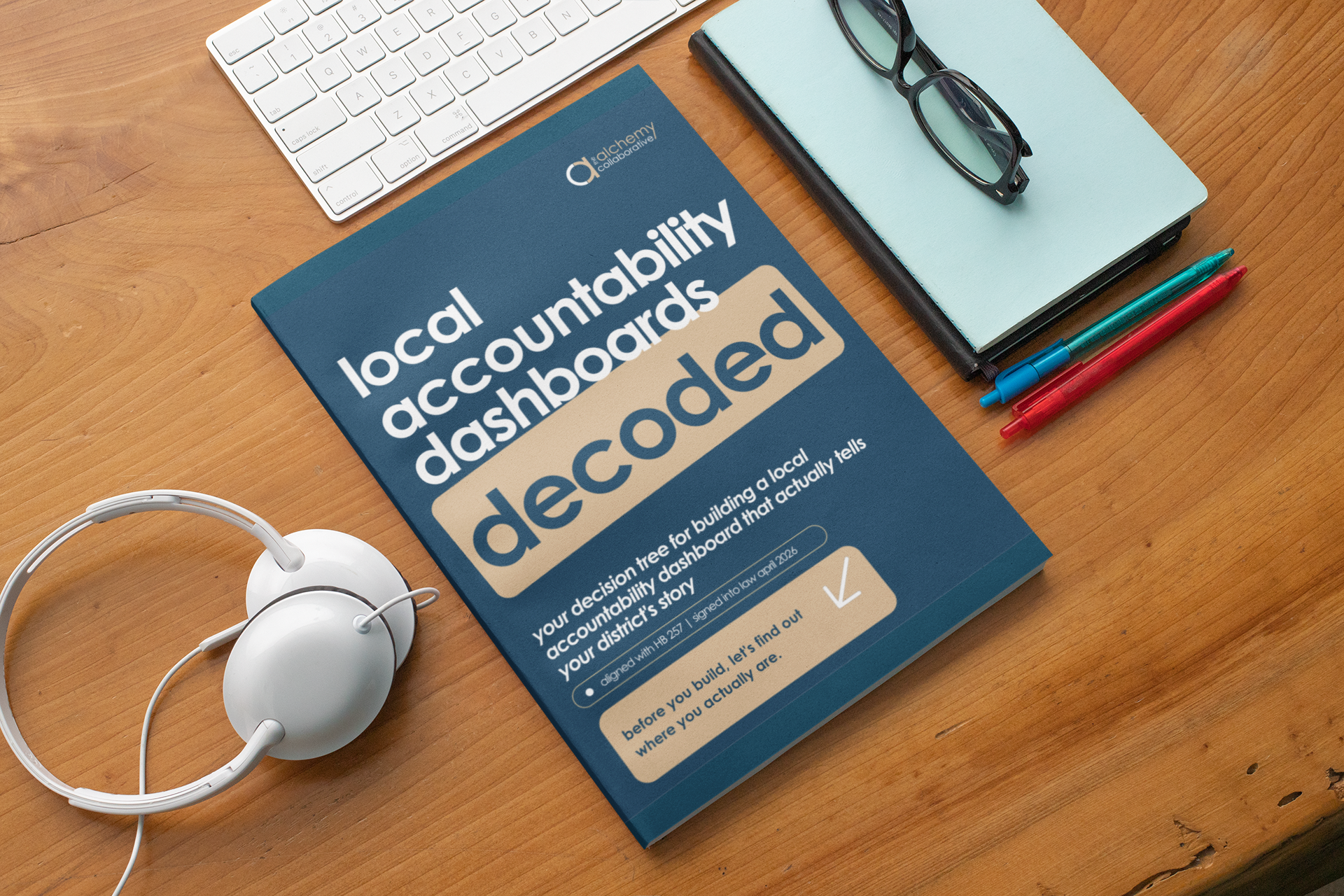
That's what Dashboards Decoded helps you see before you build.
the dashboard isn't the starting line
Here's what most districts don't realize: the dashboard is the destination, not the starting point.
You can't skip straight to building a public-facing local accountability display and expect it to work. Not because dashboards are complicated, but because dashboards expose every gap in the organizational architecture underneath them.
If you don't have a shared definition of success, the dashboard has nothing to organize around. If you don't have a portrait of learner, there's no through-line connecting the data to the competencies you say you value. If teachers aren't capturing stories consistently, the dashboard sits empty. If there's no maintenance plan, it dies six months after launch.
The districts that build dashboards that last aren't smarter or better funded. They just answer the foundational questions before they start building.
That's what Dashboards Decoded is for.
six questions that surface what's invisible
We built Dashboards Decoded as a diagnostic tool. It walks you through six questions aligned with KDE's HB 257 actions. Each one surfaces a different piece of the organizational infrastructure most districts don't realize they're missing.
The first two are gateway questions. If you can't answer yes to both, your foundation isn't in place yet. Questions 3 and 4 are independent. They each represent a different piece of dashboard infrastructure, and you can work the gaps wherever they show up. Questions 5 and 6 are related directly to the end goal: a fully-functional, easily-maintained public dashboard.
Your answers aren't a score. They're a map. Let’s walk through Dashboards Decoded one question at a time. (Haven’t checked it out yet? Download it here!)
gateway question 1: have you defined what success looks like for your district?
This is the backbone of everything else.
Do you have 3-5 pillars or domains that reflect what your community values? Not just academic scores, but the full picture of what your district is working toward?
These pillars become the organizing principle for your dashboard. They're how you structure the work you're trying to make visible.
Without them, you're building a data display with no narrative architecture. Families land on your dashboard and see disconnected metrics with no story holding them together.
Most districts have something: a strategic plan, vision statement, or draft pillars from a planning session two years ago. The question isn't whether you've written something down, but whether your community helped shape it, whether you actively organize your work around it, and whether families know what it is.
If the answer is "sort of" or "we're working on it," that's your first gap. You're not ready to build a dashboard yet. You need to go back and do the identity work first.
gateway question 2: have you defined what success looks like for your students?
This is your portrait of a learner.
It's your district's shared vision of what a graduate should know and be able to do. The competencies, character, and capabilities your community has agreed matter. It's different from academic standards. It's the human picture of success.
HB 257 recognizes vibrant learning as a required local indicator, and a portrait of a learner is how most districts ground that work.
Here's why this is a gateway question: if you don't have a portrait of learner, your dashboard can't connect the data you're displaying to the competencies you say you value. You end up with test scores and attendance rates but no through-line explaining what those numbers mean in terms of students and their success.
All of Kentucky's 171 districts have already developed portraits of learners. But having one on paper and having one that teachers, students, and families actually understand are two different things.
The question isn't just "do we have a portrait of learner?" It's "is it actually living in our classrooms?"
If teachers can't name the competencies, if students don't recognize the language, if the portrait sits in a PDF somewhere but doesn't shape how learning is designed, you've got a document problem, not an infrastructure problem. And that gap has to close before the dashboard will make sense to families.
question 3: are you documenting vibrant learning?
This question has two parts.
Part A: Do teachers and students know what authentic, vibrant learning looks like in action? Do you have an instructional framework that guides this work?
Part B: Are you collecting classroom stories consistently? Student work, teacher reflections, real examples of authentic learning experiences happening across your district?
Vibrant learning is now a required local indicator under HB 257. That means you need more than test data. You need human evidence. Stories. Examples. Proof that what you say you value is actually happening in classrooms.
Here's where most districts hit a wall: they have the framework (Part A), but they don't have the capture system (Part B).
Teachers are doing the work. Students are demonstrating competencies. But there's no protocol for collecting those stories at scale. No consistent way to route examples from classrooms to the communications team. No tagging system connecting the stories to the competencies they're illustrating.
So the dashboard sits there with quantitative data and no qualitative backing. Families see numbers but no narrative. And the disconnect undermines trust.
If you answered "almost" or "not yet" to Part B, this is the gap most districts don't see coming. You need a story capture system built into your workflow before you launch the dashboard. Otherwise, you're asking one person to manually hunt down examples every time the dashboard needs updating.
And that person will burn out.
question 4: do you have documented evidence of student success?
Portfolios. Defenses of learning. Assessment data. Student voice surveys. Real, multimodal evidence that shows what students can actually do.
This is more than just test scores. It’s documented proof of competency growth over time.
Here's why this matters: when a family lands on your dashboard and sees that their child's school is "meeting expectations" on a competency, the next thought is always "show me."
If you don't have evidence you can pull from, the dashboard becomes a claim with no backing. And that erodes trust faster than not having a dashboard at all.
Most districts have some evidence. Somewhere. In individual teacher gradebooks. In building-level portfolios. Scattered across Google Drives and filing cabinets and student devices.
The question isn't whether the evidence exists. It's whether you have an organized system to pull from so that families can see it.
If you don't, this is an infrastructure gap. And it needs solving before you go public with a dashboard that makes claims you can't back up with examples.
question 5: do you have an active, public-facing dashboard?
This is the actual display. The place your community can go to see how the district is doing on the things that matter most locally, not just the state report card.
But here's the invisible decision most districts don't realize they're making: where you host the dashboard determines whether families will actually use it.
If you build it on a separate website, families have to remember a new URL. They have to navigate a new platform. They have to leave the space where they already go for district information and hunt for accountability data somewhere else.
That fragmentation confuses families. And confusion kills engagement.
The districts that build dashboards families actually use host them on platforms families already trust. The district website. The parent app. The system where they're already checking lunch menus and reading announcements.
If you answered "not yet" to this question, you're exactly where you should be. You're thinking through the foundational questions before you build. That's the right sequence.
But if you answered "almost" (the dashboard is in development but not fully public yet), pay attention to where you're building it. If it's on a separate platform that requires families to learn a new system, that's a design gap worth revisiting now, before launch.
question 6: Is your dashboard sustainable?
Dashboards that go stale lose trust fast.
The question isn't whether you can build a dashboard. It's whether you can maintain it.
Who updates the data? How often? Can your team actually keep it current without heroic effort? What happens when the person who knows how to update it takes a job in another district?
This is the gap most districts don't see until it's too late. They build something beautiful. They launch it. Families engage. And then six months later, the most recent update is from last spring because the one person who knew how to maintain it moved on and no one else knows how the system works.
Sustainable dashboards are built on platforms multiple people can access. They're built with redundancy, with documentation, with handoff protocols baked in from the beginning.
If you answered "almost" or "not yet" to this question, this is the gap worth solving before you launch. Because launching a dashboard you can't sustain is worse than not launching one at all.
But sustainability isn't just about who can update the dashboard. It's also about when you update it and how you strategically draw families back to it.
The districts that get consistent engagement don't wait for families to randomly remember the dashboard exists. They build anchor moments into the calendar. They update quarterly, tie updates to report card windows, and send targeted communications that give families a reason to click through right now. They treat the dashboard like a living document that reflects what's happening in real time, not a static website families visit once and forget.
If you don't have a communication rhythm planned before you launch, families will engage once out of curiosity and never come back. And that's a maintenance problem disguised as a communication problem.
what your answers mean
If you answered yes to Questions 1 and 2, your foundation is solid. You've done the hard identity work. Now it's time to build the infrastructure that makes the dashboard worth looking at.
If you answered "almost" to several questions, you have more in place than you think. What you need now is someone to help you fill the gaps, connect the pieces, and build the systems that keep the work moving.
If you answered "not yet" to Questions 1 or 2, that's not a problem. It just means you know exactly where to focus first. The dashboard isn't the starting line. It's the destination. And you're not alone in building toward it.
you don't have to build this alone
HB 257 is signed. KDE is authorized to provide up to $15,000 per district to offset development costs. The window is open.
But before you say ‘yes’ to that funding, before you commit to a timeline, before you choose a platform, take 10 minutes and walk through the six questions in Dashboards Decoded.
Your answers will show you where you actually are. Not where you hope to be. Not where you think you should be. Where you actually are right now.
And that clarity is worth more than jumping straight to building something you're not ready to sustain.
We built Dashboards Decoded because we kept watching districts skip the foundational questions and pay for it later. Dashboards that launched strong and died within six months. Dashboards that looked good to external audiences but didn't actually serve the families they were built for. Dashboards that exposed every gap in the organizational architecture underneath them.
The districts that avoid those outcomes are the ones that answer the foundational questions first.
If you want to walk through Dashboards Decoded, you can download it here.
And if you're building this work and want to talk through what you're seeing, we're here. We've been in these conversations with state leaders for months now, brainstorming how to bring communications directors and accountability teams into the same room so this work doesn't keep happening in silos.
That convening is still being shaped. But if you're a superintendent thinking "we need this" or a communications director thinking "finally, someone sees the gap," let us know. We'll make sure you're part of the conversation when it happens.
read our most recent posts
the golden lens
sign up to our newsletter to stay updated!
Contact Us
thanks for signing up!
oops, there was a sign-up error.
please try again later.
SHARE THIS