
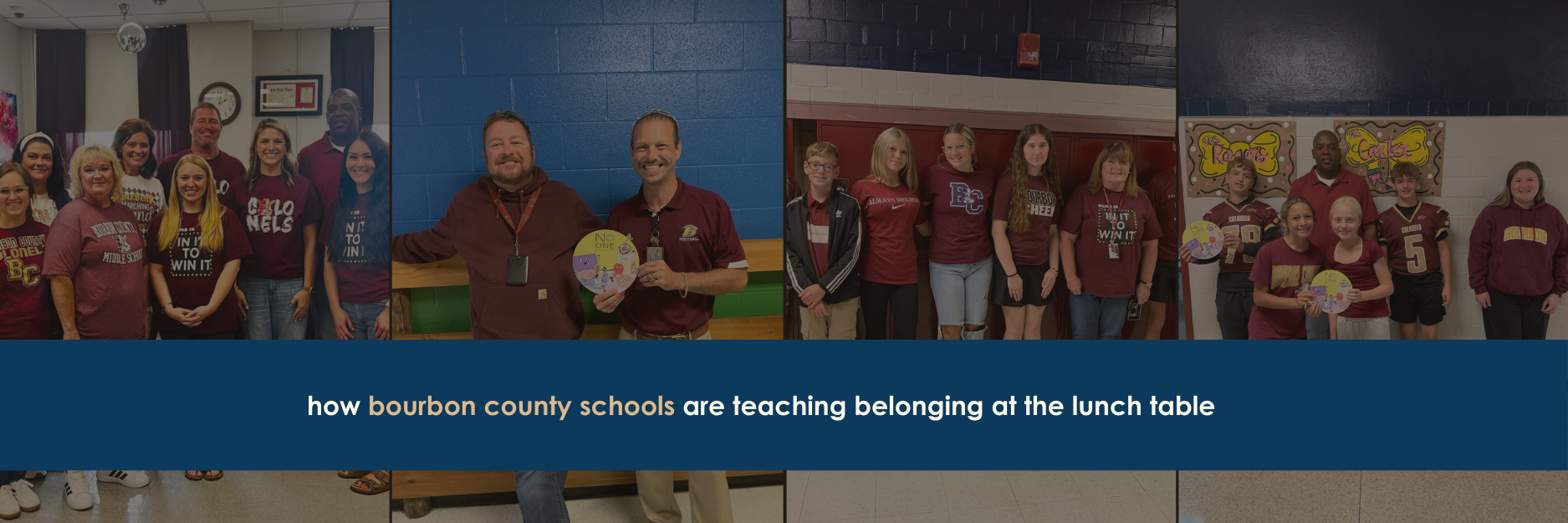

how bourbon county schools are teaching belonging at the lunch table


By Karri Alchemy September 2, 2025

a small act with a big impact

At Bourbon County Schools, students are proving that leadership doesn’t just happen on a stage or in the classroom. Sometimes, it happens at the lunch table.


This spring, the district joined the No One Eats Alone initiative, a national program from Sandy Hook Promise that encourages students to step outside their usual circles and invite someone new to sit with them. The idea is simple: no one should have to eat lunch alone. But the impact? It changes the entire culture of a school.


why lunch tables matter

Lunchtime might seem ordinary, but it’s one of the most powerful places where school culture is built. Who you sit with, who you invite, and who you leave out sends a message about belonging. When students notice who’s sitting alone and take the step to invite them in, they are shaping the future of their school in real time.


For Bourbon County, this program reinforces a commitment to student leadership, empathy, and community trust. When students take responsibility for creating a welcoming environment, they brighten a friend’s day and, at the same time, lay the foundation for safer, stronger schools.


servant leadership in action

At AC, we often talk about servant leadership as the heartbeat of what makes schools thrive. Leadership is less about power or position and more about noticing needs, listening with empathy, and creating space where others can flourish.


That’s exactly what the No One Eats Alone initiative looks like in action. A student sees a classmate by themselves and thinks, You belong here. That one invitation reflects a larger truth: culture shifts when we lead with service.


planting a vision of belonging

The program also speaks to our value of vision planting. Students aren’t just fixing a lonely moment; they’re imagining a future where no one is left out. This vision of inclusion ripples outward (from lunchrooms to classrooms to athletic fields) until it becomes part of the DNA of the district.


When schools give students ownership of culture, they spark innovation and creativity. They remind us that even the youngest leaders can dream of (and help build) a better tomorrow.


why it matters for communications and culture

We know from experience that initiatives like this aren’t just about feel-good stories. They are powerful communications opportunities for schools:

  • They demonstrate values in action.
  • They give families confidence that their children are cared for.
  • They strengthen trust between the district and community.


When leaders consistently tell stories of belonging, they reinforce the message: this is a district where every student matters.


abundance at the table

This story also reminds us of something bigger: belonging is abundance. In our work, we often describe abundance as moving from scarcity to generosity, from exclusion to inclusion, from pressure to peace.


Seeing students in Bourbon County create space at the table is a picture of that same spirit. It’s a reminder that when we cultivate cultures of welcome, we plant seeds of abundance that grow far beyond a single lunch period.


the takeaway for leaders

For superintendents, principals, and communications directors, the message is clear: small, intentional programs can have lasting impact. By investing in student-led initiatives that promote belonging, schools aren’t just meeting short-term needs... they’re building long-term trust.


And for us at AC, it’s a chance to celebrate what we hope every district experiences: a culture where no one eats alone, no one leads alone, and no one feels like they have to carry it all by themselves.


want to take this reflection deeper?

Explore abundance by ac, our sister space for educators and leaders, where we share faith-rooted meditations and resources to help you lead from peace.

read our most recent posts

By Brooke Goff July 21, 2026
Most principals are watching local accountability happen from the hallway. You don't have to wait for an invitation. There is a teacher in a school you probably know. Maybe you have someone like her on your team right now. She runs the PLCs. She sits in on planning sessions across grade levels. She knows which classrooms are doing cross-curricular vibrant learning work this quarter, and she knows which teachers need extra support to pull it off. When something remarkable happens in a student's learning, she finds out. She takes the photos. She writes the caption. She is the reason the school's story gets told at all. And she is one person. When local accountability arrives at your building (and it is arriving) it is going to ask for documented vibrant learning evidence, a Portrait of a Learner that lives somewhere public, data that shows your community what your school actually stands for. And if your answer to any of those requests runs through one person's head, one person's phone camera, one person's memory of what happened in third period on a random Tuesday in October, you have a fragility problem. Not a people problem. A systems problem. And it is fixable, but only if you start now, before the district finishes building the dashboard you will eventually be feeding. Here is what I want principals to know before anything else: you are not behind. You are not failing. The local accountability conversation in Kentucky has been happening almost entirely at the district level, and the assumption buried inside a lot of that work is that principals are naturally in the loop. That superintendents are passing information down. That buildings are ready. Most of them are not. And that is not the principal's fault.  What is within a principal's control right now is whether the work already happening in their building gets captured in a way that will matter later. Not a new initiative. Not a new platform. Not a new committee. Three practices, intentionally done, that most strong principals are already doing accidentally.

By Brooke Goff July 7, 2026
We didn't raise our rates. A client assumed we had. Four systems that explain what changed -- and what AI made possible that wasn't possible before.
By Brooke Goff June 22, 2026
What happens when your culture lives only in people's heads? The three school communications systems every organization needs but rarely builds.
the golden lens

sign up to our newsletter to stay updated!

Contact Us

SHARE THIS

learn how we can help