when the data gets a face: how allen county built a local accountability dashboard that actually works
By Brooke Goff • April 2, 2026
Allen County built something most Kentucky districts are still trying to name. Here's what we saw
Your district already has the data. It already has the platforms. What it's probably missing is the system that connects them.
There's a moment in this work that I live for.
It usually happens on a Zoom call. Someone shares their screen. There's a pause. And then the person on the other end — the superintendent, the principal, the communications director who's been quietly grinding away on this for months — goes quiet in a way that means something cracked open.
That happened with Travis Hamby.
Travis is the superintendent in Allen County, Kentucky, and he came into this work skeptical. He'd seen dashboards before. He'd watched other Kentucky districts chase shiny solutions that added to staff workloads without adding to community trust.
He was, in his own words, "less excited today than he once was" about the whole local accountability push.
And then he saw what we'd built together.
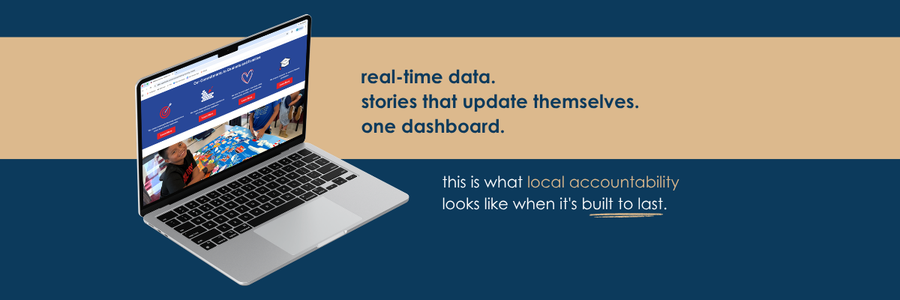
We're not ready to share the full dashboard publicly yet — Allen County is still waiting on data from one partner before launch. But what we can share is the story of how it came together. Because what we built in Allen County isn't just a dashboard. It's a model for what happens when a district finally closes the gaps that have been quietly undermining this work everywhere else.
the real problem isn't missing data — it's missing connections
When HB 257 put local accountability on Kentucky's radar, most of the early conversations sounded the same.
We need a dashboard. We need stories. We need something the community can actually understand.
What nobody was saying out loud (but what our team kept seeing) was something deeper. Districts weren't just missing a tool. They were missing a system. And underneath that missing system were three specific gaps that, once you name them, you start seeing everywhere.
Every district leader navigating this work can build a local accountability system that actually sustains itself by closing three critical gaps most districts don't know they have.
Here's what those gaps look like.
gap one: the data gap
Most districts have more data than they know what to do with.
It lives in PowerSchool. In their state reporting platform. In culture surveys that are collected and filed. In attendance dashboards that update in real time and then sit, invisible, on a server somewhere. The data exists. It's just scattered across disconnected systems, formatted for policy audiences, and completely unusable in the context of community comprehension.
This is what we found in Allen County, and what surprised us was how much was already there.
Travis pulled up his screen during one of our early working sessions and showed us six live dashboards he'd already built.
Attendance data.
Culture survey scores.
Trauma-informed care process measures.
All of it is updating in real time. All of it is drillable by the school, and eventually by the subgroup. Six of eight accountability pillars already had live data behind them.
The data wasn't missing. It just hadn't been connected to anything a family member could find, read, and trust.
That's the data gap. It's not an absence of information. It's a translation problem between the formats data lives in, and the formats communities can actually use.
gap two: the platform gap
Here's a pattern we've seen across Kentucky districts: leaders invest in powerful communication platforms (Apptegy, ParentSquare, FinalSite, and others) and then use them for exactly one thing.
Push notifications. Weekly updates. The stuff that goes out and disappears.
What almost no one is doing is treating those platforms as accountability infrastructure. As the place where the living story of the district gets captured, organized, and made visible over time.
Allen County already had Apptegy. Teachers and building leaders were already posting to it: stories about students, classroom updates, recognition moments. That content was being created. It just wasn't being routed anywhere that mattered for accountability purposes.
What we built (along with some custom code that doesn't exist natively in Apptegy's system) was a tagging protocol that changes that entirely.
A teacher writes a post. Tags it "Profile of a Patriot." That story automatically surfaces on the Profile of a Patriot domain page of the accountability dashboard.
No extra form.
No duplicate submission.
No waiting for a communications coordinator to manually update a website.
The three most recent tagged stories sit at the top. When a new one comes in, the older ones move to an archive.
Travis got it immediately. "What I like about it," he said, "is it pushes our people to be more intentional."
That's the platform gap closing.
The tool was already paid for. It just needed a protocol to make it do the right work.
gap three: the protocol gap
This is the gap most districts never get to because the first two feel urgent enough.
But the data gap and the platform gap are solvable with the right technical build. The protocol gap is different. It's a leadership and communication question. And without closing it, the first two fixes eventually break down.
Here's what it looks like in practice: a district builds a dashboard. It looks great at launch. Six months later, the stories haven't been updated. The data embed stopped refreshing. Nobody owns the process of keeping it alive because the responsibility was never clearly distributed.
What Allen County has (partly because of the tagging system, partly because of the culture Travis has built within the district) is a shared communication protocol where story capture doesn't bottleneck at the top.
Teachers tag.
Leaders contribute.
The system routes content to the right place automatically.
And the accountability infrastructure updates itself because the people already doing the work are the ones feeding it, and it's not left to disappear on the to-do list of an overworked, single coordinator who's supposed to find time between everything else to ALSO write stories.
This isn't just a content workflow. It's a trust infrastructure.
When districts distribute the ownership of their story across their leadership, the story stays honest. It stays current. And it stays connected to what's actually happening in classrooms, not just what looks good in a report.
what's behind this work
Allen County didn't get here alone.
This work was made possible through our partnership with the University of Kentucky Center for Next Generation Leadership (UK NextGen) who serve as the thought leaders and driving force behind Kentucky's Local Laboratories of Learning initiative.
UK NextGen sponsored the development of Allen County's accountability dashboard, and they've been instrumental in helping districts across the state understand what this work can actually look like at the local level.
Allen County has been part of the L3 network since Cohort 1 — since fall of 2021. They've been doing this longer than most. And what Travis has built, with UK NextGen's support and alongside our team, is what the L3 vision was designed to produce: a system that answers the accountability question honestly, in plain language, for the community it serves.
The Kentucky Department of Education, through the L3 initiative, has been asking districts a simple but weighty question: what are you actually doing for kids in this community?
Allen County is building the answer. In real time. With stories that update themselves and data that doesn't wait to be published.
what this looks like when it's finished
We're a few weeks out from Allen County's public launch, and we're genuinely proud of what's being built.
Five pages.
A definition of success in plain language.
An interactive shield (Allen County's symbol) that anchors navigation across every pillar. A design that's consistent across every domain page, intentionally, because overwhelm is the enemy of trust.
10,300 artifacts submitted toward the Profile of a Patriot.
5,400 approved.
315 students who have completed full badge sets — documented evidence of who they are becoming as learners, not just what they've scored on a test.
The only pillar not yet live is career and future readiness — a data sourcing timing issue, not a will issue.
It's coming.
What strikes us every time we look at it is how much this shifts the accountability conversation. Not data or story. Both. Quantitative and qualitative, held together by a design clear enough that a family member can find what they're looking for without a tutorial.
That's the Goldilocks balance. And it's harder to build than it sounds.
the gaps in your district
We've seen a lot of local accountability work across Kentucky at this point.
Almost every district we talk to has data.
Almost every district has invested in communication platforms.
Almost every district has people who care deeply about getting this right.
What most of them are missing is the connective tissue. The tagging protocol. The shared ownership structure. The translation layer between what data exists and what a community can actually read and trust.
Those are the gaps. And they're closable.
If you're a district leader trying to figure out what a sustainable accountability system actually looks like — or if you've built a dashboard that's already gone quiet — we'd love to talk.
What would it change for your community if the story of your schools updated itself?
The Alchemy Collaborative partners with Kentucky school districts to build local accountability infrastructure, communication systems, and storytelling frameworks that help communities understand and trust their schools. This work in Allen County was made possible through the support of UK NextGen and the L3 initiative. To learn more about the L3 network, visit the Kentucky Department of Education.
read our most recent posts


the golden lens
sign up to our newsletter to stay updated!
Contact Us
thanks for signing up!
oops, there was a sign-up error.
please try again later.
SHARE THIS